
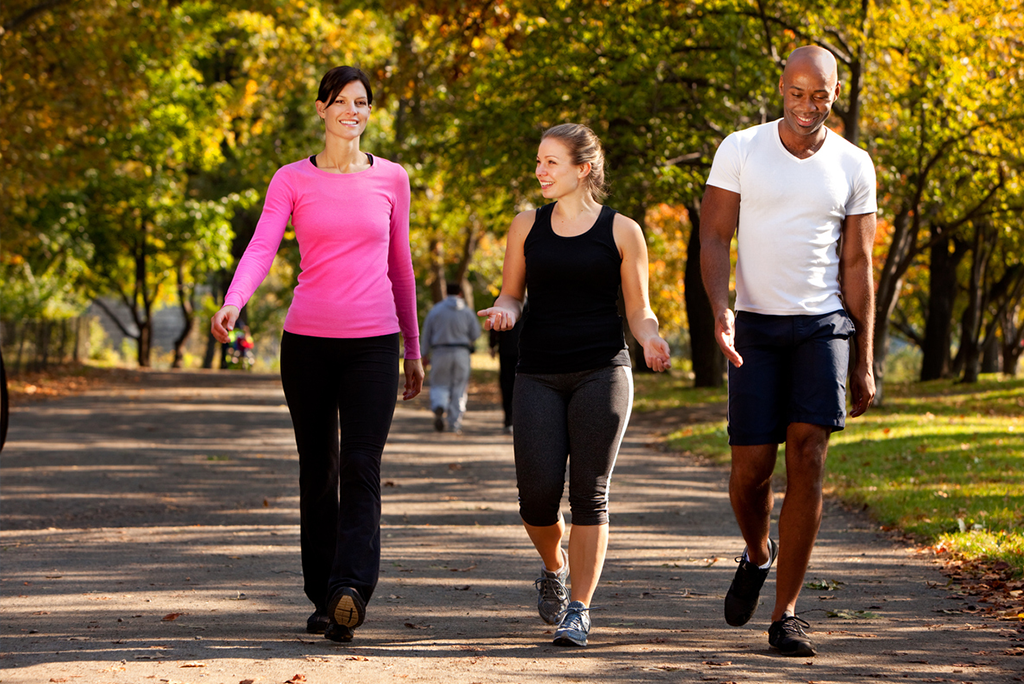
Discover why regular outdoor walking supports heart health, blood sugar, stress, and sleep.
When patients think about improving their health, they often picture intensive workouts or restrictive diet plans. However, one of the most evidence-supported and sustainable interventions is much simpler: regular outdoor movement.
Emerging research demonstrates that time spent outdoors, particularly when combined with light-to-moderate physical activity, positively influences cardiovascular health, metabolic regulation, stress physiology, and sleep patterns.
🫀 It’s Good for Your Heart | Cardiovascular Benefits
Your heart is a muscle, and like any muscle, it thrives with regular, consistent use. Moderate-intensity aerobic activity – like a brisk walk around your neighborhood – is one of the most well-studied ways to protect your cardiovascular health.
The U.S. Department of Health and Human Services recommends that adults aim for at least 150 minutes of moderate-intensity physical activity per week – that’s just about 20–25 minutes a day. Research consistently shows that hitting this target is associated with a meaningfully reduced risk of heart disease, high blood pressure, and overall mortality (U.S. Department of Health and Human Services, 2018).
What makes outdoor walking especially heart-friendly is how sustainable it is. You don’t need a gym. You don’t need a trainer. You just need a good pair of shoes and a safe route. Studies show that outdoor walking tends to feel easier than equivalent indoor exercise – meaning people actually stick with it longer (U.S. DHHS, 2018).
Consistency is what creates results. And walking outside makes consistency feel effortless.
💙 Concerned about your heart health or blood pressure? Our team at Healthonomic is here to help. Learn about our Blood Pressure and Heart Disease services →
Blood Sugar Regulation and Weight Management
Here’s one of our favorite pieces of research to share with patients: a study published in Diabetes Care found that just three 15-minute bouts of moderate walking after meals significantly improved 24-hour blood sugar control in older adults at risk for impaired glucose tolerance (DiPietro et al., 2013).
That’s remarkable. Not an hour at the gym. Not a major dietary overhaul. A short walk after eating.
For anyone managing prediabetes, type 2 diabetes, or weight concerns, post-meal walking is one of the gentlest and most evidence-supported habits you can build. It helps your muscles use glucose more efficiently, reduces post-meal blood sugar spikes, and supports insulin sensitivity over time.
And when it comes to weight management, the research is equally encouraging – regular physical activity is one of the strongest predictors of long-term weight maintenance (Jakicic et al., 2019).
The key message here is this: consistency matters far more than intensity. A 20-minute walk after dinner, done regularly, will do more for your metabolic health than an occasional intense workout followed by weeks of inactivity.
🌿 Managing diabetes or prediabetes? We offer personalized diabetes management at all three of our locations. Explore our Diabetes Management services →
Stress Reduction and Cortisol Regulation
We all know stress is bad for us. But the specific ways chronic stress affects the body are worth understanding, because they connect directly to conditions we treat every day at Healthonomic.
When you’re chronically stressed, your body produces elevated levels of cortisol, a stress hormone. Over time, high cortisol is linked to weight gain (especially around the midsection), elevated blood pressure, poor sleep, and increased inflammation. It’s a cycle that feeds on itself.
Here’s the good news: spending time in natural environments measurably reduces cortisol levels. A landmark study by Park et al. (2010) on the Japanese practice of Shinrin-yoku (forest bathing) found significant physiological changes, lower cortisol, lower heart rate, and lower blood pressure after time spent in nature compared to urban environments. And a major systematic review and meta-analysis confirmed that exposure to green space is linked to improved mental health outcomes across populations (Twohig-Bennett & Jones, 2018).
You don’t need a forest. A neighborhood park, a tree-lined street, or even a quiet outdoor space near your home can provide similar benefits. The combination of physical movement and natural surroundings appears to be especially powerful.
There’s also something psychologically easier about going for a walk outside versus forcing yourself to go to a gym. It feels less like a “workout” and more like a break, which means you’re more likely to actually do it, even on stressful days when motivation is low.
🧘 Stress affecting your health? Our providers take a whole-person approach to your wellbeing. Schedule a wellness check-up →
Sleep and Circadian Rhythm Alignment
This one surprises a lot of people: what you do in the morning affects how well you sleep at night.
Your body runs on a circadian rhythm, an internal 24-hour clock that regulates sleep, appetite, energy, and hormones. One of the most powerful ways to keep that clock well-calibrated is exposure to natural light in the morning. Research by Wright et al. (2013) showed that natural light-dark cycle exposure significantly entrains the human circadian clock, improving nighttime sleep quality.
And sleep, it turns out, is deeply connected to metabolic health. Poor sleep quality is associated with disrupted insulin sensitivity, increased appetite, and higher cardiometabolic risk (Tasali et al., 2008). Getting better sleep doesn’t just make you feel more rested – it actively supports your blood sugar regulation and heart health.
So a short morning walk does double duty: it gets you moving and helps reset your internal clock for a better night’s sleep.
Turning Knowledge Into Action
Lifestyle change works best when it is measurable.
That’s why we’ve created a free, printable Spring Habit Tracker designed specifically around the lifestyle habits that support your preventive and chronic care goals. It includes space to track:
- Outdoor movement tracking
- Post-meal walks
- Hydration goals
- Medication adherence
- Sleep tracking
- Stress management
- Blood pressure monitoring
- Weight tracking
- Fasting glucose logging
- A1C documentation (if applicable)
⬇️ Download Your Spring Habit Tracker
Build consistency this season with our premium, printable Spring Habit Tracker designed to support preventive and lifestyle medicine.
Print it. Use it weekly. Bring it to your next visit so we can review your progress together.
FAQs:
Q: How much should I walk per day to see health benefits? Research supports a goal of at least 150 minutes of moderate-intensity activity per week, which works out to roughly 20–30 minutes most days. Even shorter walks provide benefit; the important thing is consistency. Always check with your provider before significantly increasing your activity level, especially if you have a chronic condition.
Q: Is walking outside better than walking on a treadmill? Both provide cardiovascular benefits. However, outdoor walking is associated with additional advantages, including natural light exposure (supporting sleep and mood), nature-related stress reduction, and higher long-term adherence. If outdoor walking is accessible and safe for you, it’s a great first choice.
Q: Can walking really help lower blood sugar? Yes, particularly walking after meals. Research shows that post-meal walking can significantly improve 24-hour glycemic control (DiPietro et al., 2013). If you’re managing diabetes or prediabetes, speak with your Healthonomic provider about how to safely incorporate this into your routine.
Q: What if I have joint pain, heart disease, or another condition? Is walking safe for me? For many people with chronic conditions, gentle walking is not only safe but encouraged. However, the right type, duration, and intensity of exercise depend on your individual health picture. Please consult your provider before starting or changing an exercise routine.
Q: When is the best time of day to walk? Morning walks offer the added benefit of natural light exposure for circadian rhythm support. Post-meal walks (especially after dinner) offer blood sugar benefits. The honest answer is: the best time to walk is whatever time you’ll actually do it consistently.
Q: Where can I find a primary care doctor near me in the south suburbs of Chicago? Healthonomic Primary Care has three convenient locations in Cook County – in Orland Park, Palos Heights, and Evergreen Park. Find your nearest location →
A Gentle Reminder from Your Healthonomic Team
You don’t have to overhaul your entire life to start feeling better. Sometimes the most powerful changes are the quietest ones – a walk around the block after dinner, ten minutes of morning sunlight, a good night’s sleep.
We’re here to support you every step of the way (literally). Whether you’re managing a chronic condition, focused on prevention, or just ready to feel a little more like yourself again, our team would love to be your partner in health.
📅 Book an appointment at Healthonomic →
📍 Serving Orland Park, Palos Heights & Evergreen Park, IL
📞 Call us: 708-671-1500
References
DiPietro, L., Gribok, A., Stevens, M. S., Hamm, L. F., & Rumpler, W. (2013). Three 15-minute bouts of moderate postmeal walking significantly improve 24-hour glycemic control in older people at risk for impaired glucose tolerance. Diabetes Care, 36(10), 3262–3268.
Jakicic, J. M., et al. (2019). Physical activity and weight loss maintenance. Obesity, 27(2), 190–204.
Park, B. J., et al. (2010). The physiological effects of Shinrin-yoku (taking in the forest atmosphere). Environmental Health and Preventive Medicine, 15(1), 18–26.
Tasali, E., Leproult, R., & Ehrmann, D. A. (2008). Slow-wave sleep and the risk of type 2 diabetes. Proceedings of the National Academy of Sciences, 105(3), 1044–1049.
Twohig-Bennett, C., & Jones, A. (2018). The health benefits of the great outdoors: A systematic review and meta-analysis of greenspace exposure. Environmental Research, 166, 628–637.
U.S. Department of Health and Human Services. (2018). Physical Activity Guidelines for Americans, 2nd edition.
Wright, K. P., et al. (2013). Entrainment of the human circadian clock to the natural light-dark cycle. Current Biology, 23(16), 1554–1558.